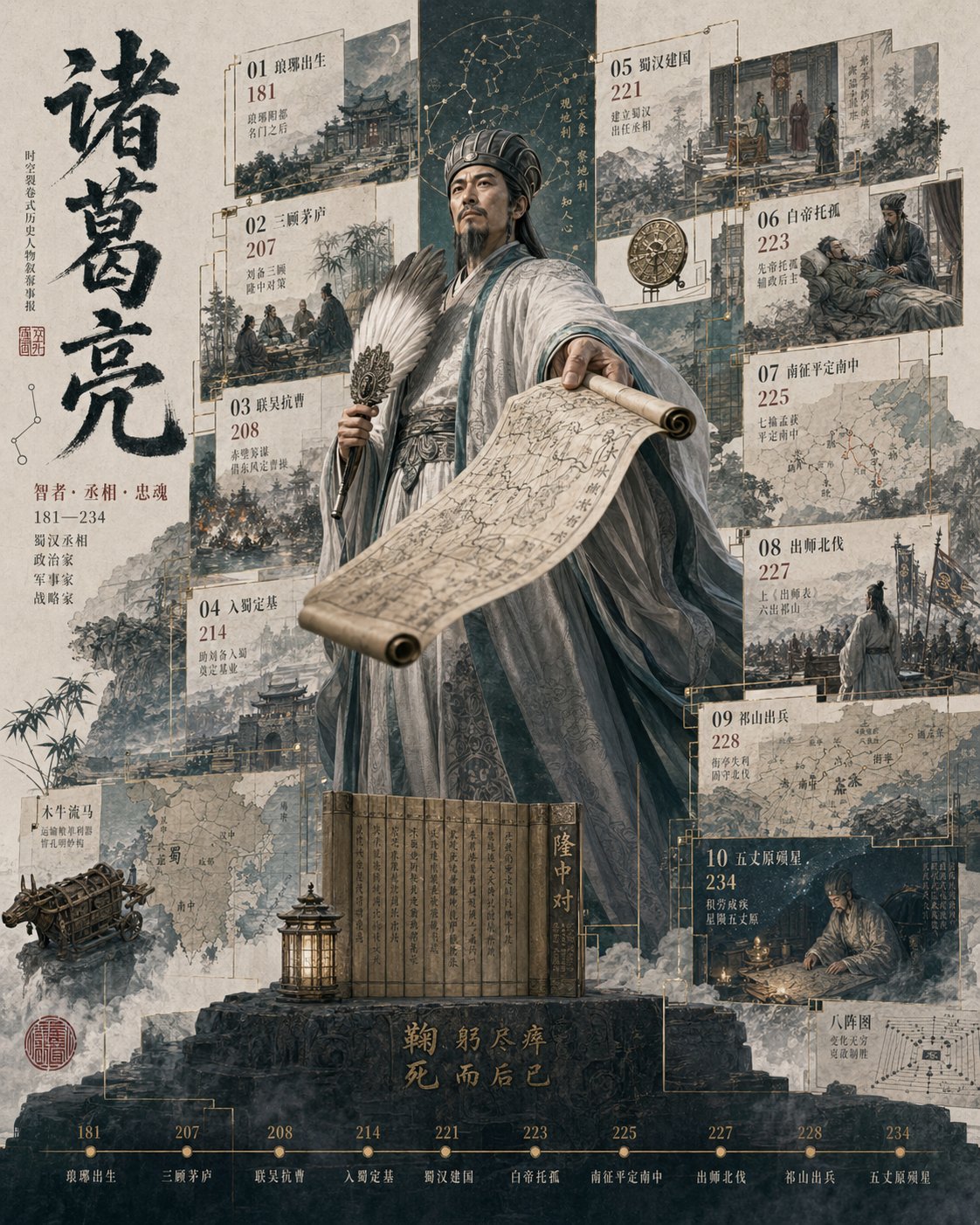
3D Historical Figure Living Statue Archive
Description
A three-dimensional historical figure statue with a book breaking out of the frame, surrounded by glowing fragments depicting life highlights, exuding an explosive aura.
Prompt
Please create a high-completion '3D Historical Breakout Biography Poster'. [User Input] Theme Person: [Person's Name] Person's Role: [Emperor / Famous General / Famous Minister / Thinker / Writer / Reformer / Military Strategist, etc.] Era Background: [Dynasty / Historical Period] Core Keywords: [Unification / Reform / Loyalty / Unity of Knowledge and Action / Northern Expedition / System / School of Mind / Golden Age, etc.] Person's Main Color Tendency: [Black-Gold-Red / Blue-Gray-Gold / Dark Red-Ink Gold / Iron Armor Deep Blue, etc.] Aspect Ratio: [3:4 Vertical] This is not an ordinary historical poster, but a high-completion historical biography poster with the core structure of 'Central full-body 3D historical figure + forward-breaking frame action + surrounding lightweight floating historical event clusters + lightweight timeline at the bottom'. The center of the image must feature a complete full-body, standing 3D historical figure. This figure is the most important main visual of the entire image, possessing strong volume, sculptural quality, monumentality, and historical aura. Clothing, headwear, armor, patterns, belts, shoes, and accessories must all correspond to the person's historical identity. The overall look should be realistic, weighty, and have cinematic impact. There must be a light yet stable monumental pedestal under the figure's feet to support the figure without overwhelming the composition. The figure cannot just stand normally; there must be a clear 'forward-breaking frame action'. The hands, arms, or key props held (such as a jade seal, imperial edict, scroll, spear, sword, military tally, hu tablet, map, book, etc.) must reach out towards the viewer, creating a strong 3D impact with perspective (near-large, far-small), depth, foreshortening, and the effect of breaking out of the frame. Special note: The key prop extending forward must be fully visible and clearly identifiable, not cropped to just a small fragment. Arrange 6 to 10 key historical milestones around the figure. These should not be heavy, orderly, flat cards, but rather 'lightweight, floating, multi-directional, translucent' historical event clusters. Each milestone can consist of 2 to 4 sub-fragments, including numbers, years, event titles, brief descriptions, small historical scene images, as well as thin gold lines, open borders, node dots, and annotation lines. The overall feeling should be like a historical archive broken down into lightweight time slices, floating and unfolding around the figure, not a standard info card layout. These event clusters should have varying orientations and spatial perspective relationships. Some lean left, some right, some turn inward, some outward, some are higher, some lower. They should have front-to-back layers. They can be partially obscured by the figure's arms, robes, or weapons, creating spatial depth. They should have a glass-like or acrylic quality, with faint glowing edges, incomplete borders, and slight misaligned overlaps. The information should be detailed but visually light, and must not overpower the central figure. Place the main title '[Person's Name]' on the left side of the image, using a font that evokes Eastern historical calligraphy, stele inscription, or ink stroke style. You can add birth/death years, role labels, keyword summaries, and a highly concise subtitle next to it. The title area should be stable, simple, restrained, and not cluttered. A light, simple, and detailed horizontal timeline must be placed at the bottom, connecting the important years of the figure's life and corresponding to the surrounding historical event clusters. The timeline should resemble a curatorial guide line, a museum time scale, or a historical index line, using thin gold lines, small dots, concise years, small text labels, and a few decorative nodes. Do not make it a heavy black bar or a large bottom information block. The background should be based on cream-colored rice paper, antique paper, old archive paper, or light museum walls. The overall tone should be low saturation, clean, and restrained. You can add subtle map textures, silhouettes of ancient buildings, document fragments, seals, gold connecting lines, annotation lines, nodes, territory outlines, etc., to create a light and rational historical archive exhibition feel. The entire image must establish a clear contrast: Central Figure: Heavy, realistic, three-dimensional, strong lighting and shadows, strong volume. Surrounding Historical Nodes: Light, transparent, floating, slightly glowing, delicate and rational. Figure Action: Surging forward, breaking the frame, possessing spatial explosiveness. Bottom Timeline: Light and restrained, only responsible for containing information. If requirements conflict, please prioritize: 1. Complete full-body central figure 2. The forward-extending prop is fully visible and has strong 3D impact 3. Surrounding event clusters are light and floating, not heavy cards 4. Central figure is 'heavy', information system is 'light' 5. Bottom timeline is lightweight, clear, and does not compress the image If the model has difficulty precisely controlling a large amount of small text, prioritize clarity of the person's name, years, numbers, and event titles. Brief descriptions can be moderately simplified or space reserved for post-processing typography.