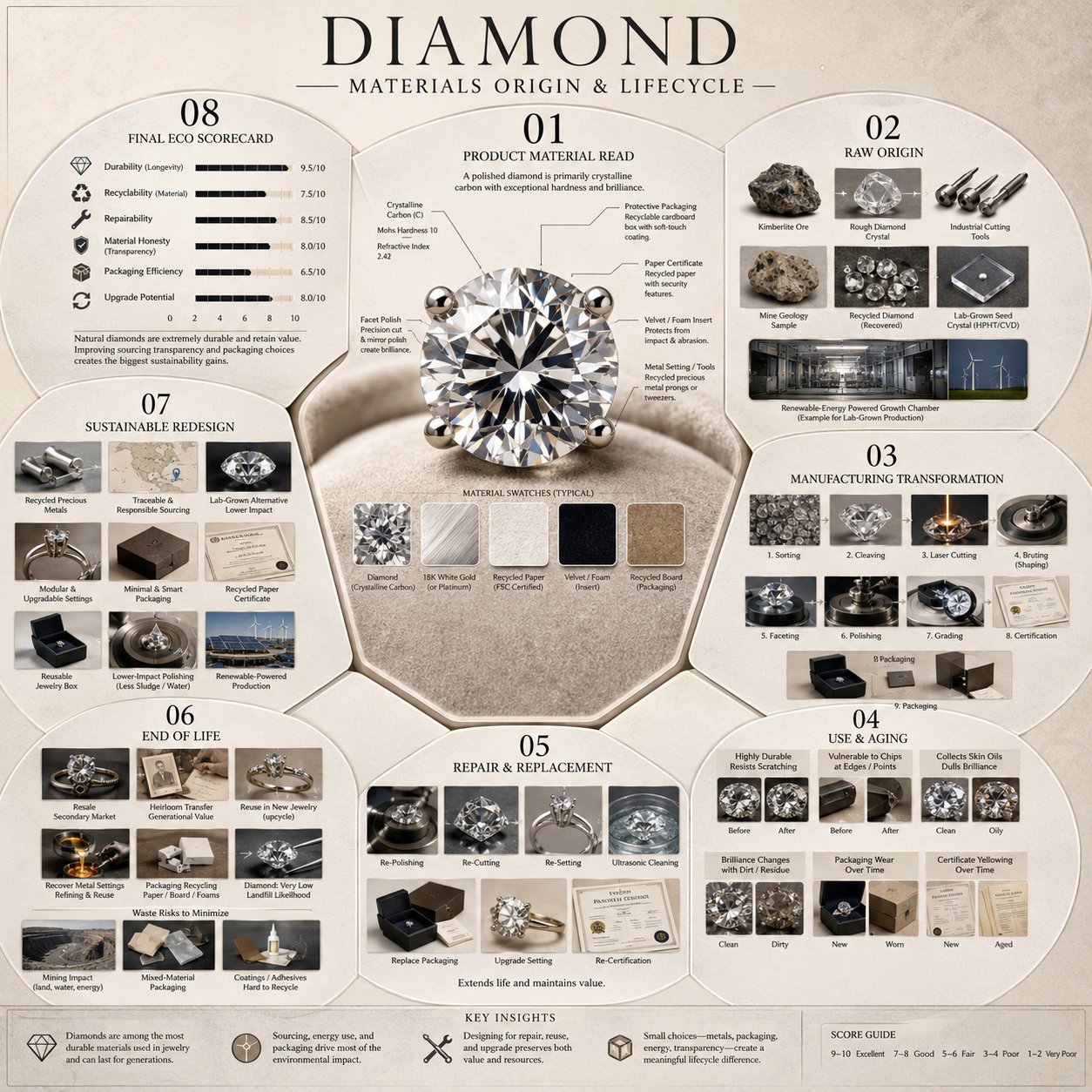
Coffee and Diamond Lifecycle Comparison Poster
Description
A premium sustainability poster comparing the lifecycle of coffee and diamond, featuring circular flow diagrams, material swatches, and macro texture photography.
Prompt
Act as a world-class materials scientist, sustainability strategist, industrial designer, and visual journalist. Create a "Materials Origin & Lifecycle Poster" for $ input. The goal is to explain what the product is made from, where those materials may come from, how they age, and what happens at end of life. Infer: $ material_families $ surface_finishes $ likely_supplier_inputs $ carbon_intensive_parts $ repairable_parts $ recyclable_parts $ waste_risks $ better_material_options Layout: Use a circular lifecycle diagram combined with product closeups and material samples. Sections: 01 PRODUCT MATERIAL READ Show $ input with labels for visible materials: plastic, metal, glass, textile, leather, foam, rubber, wood, ceramic, coating, adhesive, electronics, paper, ink, etc. 02 RAW ORIGIN Show raw material origins as visual fragments: ore, polymer pellets, cotton, wool, wood pulp, sand, rubber, leather, recycled flake, bio-resin, aluminum billet, circuit substrate. 03 MANUFACTURING TRANSFORMATION Show how raw materials become parts: molding, weaving, coating, stamping, casting, machining, dyeing, laminating, bonding, polishing, printing. 04 USE & AGING Show how materials change over time: scratches, patina, discoloration, compression, fraying, cracking, gloss wear, oxidation, dents, fading. 05 REPAIR & REPLACEMENT Show which parts could be replaced, cleaned, refinished, patched, re-covered, re-coated, re-stitched, or upgraded. 06 END OF LIFE Show recycling, disassembly, landfill risk, parts harvesting, resale, refurbishment, composting, or material separation. 07 SUSTAINABLE REDESIGN Show alternative materials and better construction choices: fewer adhesives, modular screws, recycled content, mono-material parts, replaceable batteries, removable covers. 08 FINAL ECO SCORECARD Rate durability, recyclability, repairability, material honesty, packaging efficiency, and upgrade potential. Style: Premium sustainability report poster, circular flow layout, material swatches, macro texture photography, clean diagrams, warm neutral background, refined editorial typography, 8k realism. Negative: No fake environmental claims, no greenwashing badges, no generic brand board, no random leaves, no messy infographic, no watermark.